Internal pressure hollow fiber ultrafiltration uses an inside-out capillary membrane configuration. Raw water flows through the fiber lumen under pressure, and permeate exits radially through the membrane wall. This design delivers superior clogging resistance, water recovery rates up to 95% and simple maintenance. As a result, it is the preferred choice for reverse osmosis (RO) pretreatment. It also suits drinking water purification and industrial process water treatment.
Grand View Research valued the global ultrafiltration membrane market at approximately USD 3.2 billion in 2024. It projects growth to USD 5.8 billion by 2034, a CAGR of 6.2%. Internal pressure modules account for a growing share of this demand. Their larger flow channels tolerate higher suspended solids loads, which means less pretreatment and lower energy input.
What Is Internal Pressure Hollow Fiber Ultrafiltration?
Internal pressure hollow fiber ultrafiltration is a membrane separation technology. Feed water flows through the lumen (inner channel) of hollow fiber membranes. Permeate then passes radially from inside to outside through the membrane wall. The hollow fibers typically have an inner diameter of 0.6-6 mm. Classified as capillary UF membranes, they provide a large flow channel that resists clogging by suspended particles.
A module consists of hundreds to thousands of hollow fiber filaments housed in a cylindrical membrane shell. Epoxy end seals at both ends separate the feed side from the permeate side. This ensures that raw water must pass through the membrane wall to reach the permeate collection space. This configuration differs fundamentally from external pressure UF, where feed water enters the shell side and permeates inward. For the structural details of the membrane itself, see our guide to the hollow fiber ultrafiltration membrane.
Key Characteristics of Internal Pressure Hollow Fiber Ultrafiltration
The internal pressure hollow fiber ultrafiltration design offers several distinct technical advantages. These benefits drive its widespread adoption across water treatment applications.
| Characteristic | Description | Benefit |
| Capillary membrane structure | Inner diameter 0.6-6 mm | Large flow channel resists clogging |
| Cross-flow filtration | Vertical turbulent flow across membrane surface | Self-cleaning effect reduces fouling |
| High water recovery | Recovery rate up to 95% | Minimal wastewater generation |
| Low-pressure operation | Operating pressure 0.1-0.3 MPa | Low energy consumption, simple maintenance |
| Room temperature separation | No phase change or heating required | Suitable for heat-sensitive materials |
| Thorough flushing | Clean water mutual flushing method | Fast flux recovery, low water attenuation |
The ultrafiltration membrane filtration principle forms the scientific basis for these characteristics. It explains how pore size and pressure differential work together to achieve effective separation.
Working Principle of Internal Pressure UF Systems
In an internal pressure hollow fiber ultrafiltration system, a feed pump pushes raw water into the hollow fiber lumens. The flow path then follows a specific sequence that maximizes filtration efficiency and membrane longevity.
Feed water entry: Raw water enters the hollow fiber from one end of the module. It then flows through the fiber lumen under applied pressure (0.1-0.3 MPa).
Radial permeation: Driven by the pressure differential, water penetrates the membrane wall from inside to outside in the radial direction. The membrane pore size (0.01-0.1 μm) allows water and dissolved solids to pass while blocking particles, bacteria and colloids.
Permeate collection: The filtered water (permeate) exits the membrane wall. It collects in the shell-side space and flows out through the permeate port.
Concentrate discharge: Retained contaminants and a portion of the feed water (typically 5-10%) exit from the opposite fiber end. This stream forms the retentate, maintaining continuous cross-flow. Such flow prevents particle accumulation.
Periodic flushing: Automatic clean water mutual flushing cycles reverse or accelerate the flow. This dislodges accumulated particles from the fiber walls and restores flux without chemical cleaning.
This continuous flow design keeps the membrane surface constantly swept by turbulent flow. Consequently, it reduces fouling rates and extends the interval between chemical cleanings. Our guides explain how flow, pressure, recovery and temperature interact in real systems. See optimizing the ultrafiltration membrane process in water treatment and ultrafiltration membrane performance factors for details.
Advantages of the Internal Pressure UF Design
Compared with external pressure UF, internal pressure hollow fiber UF offers several specific advantages:
- Excellent clogging resistance: The larger inner diameter (0.6-6 mm) of capillary membranes accommodates larger suspended particles without blocking. This reduces the need for fine pretreatment.
- Thorough cleaning capability: Forward flushing flows directly through the fiber lumens where most fouling occurs. This provides more effective cleaning than backwashing in external pressure systems.
- Low water attenuation rate: The clean water mutual flushing method rapidly restores permeate flux. It typically recovers above 95% of initial flux after each flushing cycle.
- Simple installation: Modules install vertically or horizontally with minimal support structure. For residential applications, the household ultrafiltration membrane guide offers practical installation guidance.
- High recovery rate (95%): The cross-flow design and efficient flushing minimize the wastewater stream. This makes internal pressure UF more water-efficient than many alternative technologies.
- Low operating cost: Operation at room temperature and low pressure (0.1-0.3 MPa) needs no phase change. It translates to minimal energy consumption and simple maintenance.
Application Scope of Internal Pressure UF
Internal pressure hollow fiber ultrafiltration technology serves a wide range of applications across municipal, industrial and commercial sectors. The versatility of the technology derives from its robust clogging resistance and high recovery rate.
RO Pretreatment
Internal pressure UF often serves as a pretreatment stage for reverse osmosis systems. Applications include seawater desalination, surface water treatment and well water purification. UF removes suspended solids, colloids and microorganisms down to 0.01 μm. As a result, it reduces the silt density index (SDI) to below 3. This protects RO membranes from fouling and extends their service life by 30-50%.
Pure and Ultrapure Water Production
In pure water and ultrapure water systems, internal pressure UF serves as a post-treatment stage. It runs after EDI or mixed bed deionization. It provides final sterilization and removes fine sediment particles. For industrial water treatment, it also handles sterilization, pyrogen removal and the elimination of colloidal and suspended impurities.
Drinking Water Purification
Internal pressure UF is the primary filtration technology in many mineral water and drinking water systems. This includes municipal tap water treatment and domestic water purification. The technology reliably removes bacteria, viruses and fine particulates while maintaining natural mineral content.
Industrial Process Water
In the food and beverage industry, internal pressure UF concentrates, purifies and clarifies liquids. Typical duties include fermentation, enzyme preparation and pharmaceutical production. It also clarifies wine by removing turbidity from fruit wine and rice wine. In addition, it purifies water in medical and electronic manufacturing processes.
Wastewater and Reclaimed Water
Internal pressure UF systems handle industrial wastewater, domestic wastewater and reclaimed water treatment. The high recovery rate (95%) minimizes the volume of wastewater concentrate, reducing disposal costs. Applications include cooling water reuse, condensate water recovery and tertiary treatment for water recycling.
Other Applications
- Aquaculture water purification — removes suspended solids and pathogens from recirculating systems
- Municipal tap water advanced treatment — for villages, enterprises, hotels and public facilities
- Beverage industry — turbidity removal from liquor, plus sterilization of fruit wine, wine and rice wine
Maintenance and Operation of Internal Pressure UF Systems
Proper maintenance keeps internal pressure hollow fiber ultrafiltration systems running at high performance. It also extends their service life:
- Forward flushing: Perform automatic flushing for 30-60 seconds every 1-4 hours of operation. The clean water mutual flushing method uses permeate water to backwash the fibers. This dislodges accumulated particles. Step-by-step procedures appear in our hollow fiber UF membrane cleaning guide.
- Chemical cleaning frequency: Schedule chemical cleaning when normalized permeate flux drops by 20-30%. Use alkaline cleaning (NaOH, pH 11-12) for organic foulants and acid cleaning (citric acid, pH 2-3) for inorganic scale.
- Membrane service life: These membranes typically last 3-5 years with proper flushing, chemical cleaning and freeze protection. Replacement comes only after this period. For preservation best practices, see our hollow ultrafiltration membrane storage and maintenance guide.
- Pre-filter protection: Install a 50-100 μm strainer or self-cleaning filter before the UF module. This protects the fibers from large debris damage.
- Freeze protection: Store UF modules above 5°C. Freezing can permanently damage the hollow fiber structure.
Conclusion
Internal pressure hollow fiber ultrafiltration remains one of the most reliable and cost-effective membrane technologies for RO pretreatment, drinking water purification and industrial process water treatment. The capillary inside-out design delivers clogging resistance, up to 95% water recovery and low-pressure operation. Together, these features reduce both capital and operating costs. The ultrafiltration membrane market is growing toward USD 5.8 billion by 2034. Internal pressure systems will keep dominating applications with higher suspended solids. There, operators also demand simple, energy-efficient maintenance.
CHIWATEC supplies high-performance internal pressure hollow fiber UF membrane modules. We also deliver complete system solutions for municipal, industrial and commercial applications worldwide. Learn more in our ultrafiltration membrane technology guide or contact our engineers for sizing and configuration recommendations.
FAQ: Internal Pressure UF Questions
Q1: What is the difference between internal pressure and external pressure hollow fiber UF?
In internal pressure UF, feed water flows through the fiber lumen, and permeate exits outward through the membrane wall. In external pressure UF, feed water flows on the shell side, and permeate collects from the lumens. Internal pressure modules have larger flow channels (0.6-6 mm inner diameter) and better clogging resistance. They also flush the fouled surface more directly. By contrast, external pressure modules typically achieve higher packing density.
Q2: What is the typical recovery rate of internal pressure UF systems?
Internal pressure hollow fiber ultrafiltration systems typically operate at recovery rates up to 95%. The cross-flow design and clean water mutual flushing minimize the wastewater stream. Only 5-10% of feed water leaves as retentate.
Q3: What operating pressure does an internal pressure UF membrane require?
Internal pressure UF systems operate at a low pressure of 0.1-0.3 MPa. Because pore size (0.01-0.1 μm) drives separation rather than osmotic pressure, the system needs no high-pressure pumping or phase change. This keeps energy consumption low.
Q4: How often should internal pressure UF membranes be cleaned?
Automatic forward flushing runs for 30-60 seconds every 1-4 hours of operation. Schedule chemical cleaning when normalized permeate flux drops by 20-30%. Use alkaline cleaning (NaOH, pH 11-12) for organic foulants and acid cleaning (citric acid, pH 2-3) for inorganic scale.
Q5: How long do internal pressure hollow fiber UF membranes last?
With proper flushing, chemical cleaning and freeze protection, internal pressure hollow fiber UF membranes typically last 3-5 years. Replacement comes only after this period.
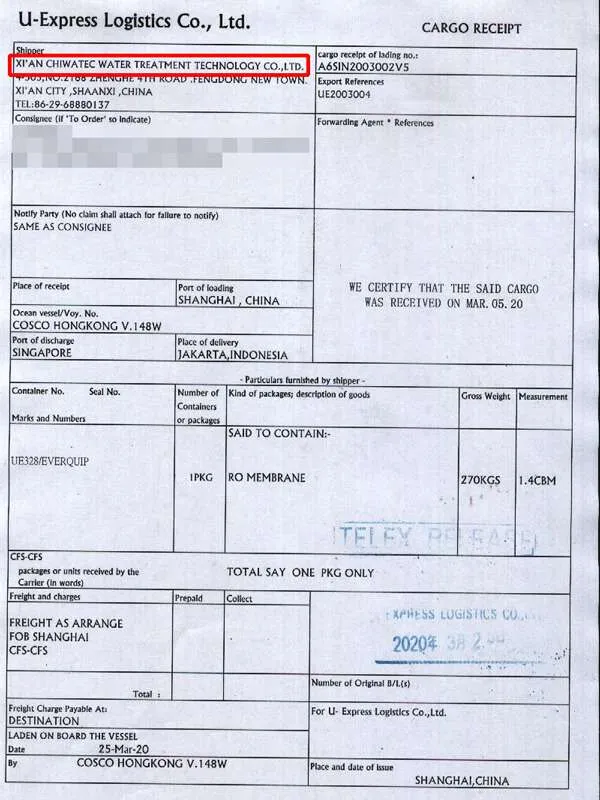
Xi’an CHIWATEC Water Treatment Technology provides RO membranes to clients both inland and overseas with more than 10 years of experience. We manufacture our own Daltonen RO membrane brand and are the official distributor of Dupont, Toray, CSM, Nitto, LG and Vontron RO membranes. Whatever product you need, we can meet your requirement.
Contact us for more information and the best price: [email protected], [email protected], [email protected]