
Ultrafiltration membrane technology has become the standard barrier process in modern drinking water plants, removing particles, colloids, and microorganisms from water with a reliability that traditional media filtration cannot match. Ultrafiltration (UF) is a pressure-driven membrane process that separates particles and microorganisms while allowing dissolved substances to pass, and its turbidity performance is outstanding: filtered water typically reaches about 0.1 NTU regardless of raw water quality. Because UF alone does not remove soluble contaminants, the industry increasingly integrates ultrafiltration with conventional treatment — biological oxidation, coagulation sedimentation, and activated carbon — to achieve complete purification. This guide explains how ultrafiltration membrane technology works, how it combines with traditional processes, and how it became the global standard for safe drinking water. For the physical principles behind the process, see our membrane separation principle guide.
1. How Ultrafiltration Membrane Technology Works
Ultrafiltration membrane technology is a crucial filtration process primarily used to separate particles and microorganisms from water. Water is pushed through a membrane with pores in the range of a few nanometers, and everything larger than the pore size — suspended solids, colloids, bacteria, and protozoa — is retained on the feed side, while water and dissolved salts pass into the permeate. This is a physical sieving barrier, not a chemical process: UF does not remove soluble substances such as ammonia nitrogen, dissolved organics, or salts. The practical consequence is that UF is chosen for particulate and microbiological removal, and it must be combined with other processes when soluble contaminants are present. The same principle applies whether the module is hollow fiber, tubular, or spiral — the membrane is the barrier, and the module geometry determines how the barrier is packed and cleaned.
2. Integrating UF with Biological Oxidation
UF alone cannot effectively eliminate ammonia nitrogen, which is a common problem in polluted surface water. Integrating biological oxidation with ultrafiltration significantly boosts the removal rate of ammonia nitrogen, and it also increases the removal efficiency of chemical oxygen demand (COD) and biochemical oxygen demand (BOD). The combined process works because the two mechanisms are complementary: biological oxidation converts dissolved ammonia and organic matter into biomass and simpler compounds, and the UF membrane then removes the resulting particles and microorganisms. This is the core design pattern in modern ultrafiltration membrane technology — the membrane is the final physical barrier, while upstream biological, chemical, and adsorptive processes handle the dissolved load. Every large ultrafiltration membrane technology plant in polluted-source service follows this same two-stage architecture.
3. Coagulation Sedimentation and Turbidity Control
Incorporating a coagulation sedimentation unit improves the treatment of medium and small molecular organics, especially trace organic pollutants, while enhancing turbidity removal and prolonging membrane life. Typically, the turbidity of water after ultrafiltration is about 0.1 NTU, largely independent of raw water turbidity — the membrane barrier is that effective. However, when raw water is highly turbid, flushing water needs increase and the filtration cycle shortens, because the membrane surface must be cleaned more often to remove the heavier particle load. Adding coagulation sedimentation upstream of the membrane reduces that load, keeps the filtration cycle long, and protects the membrane from abrasive particles. The result is lower operating cost and a longer membrane life — the two metrics that decide whether an ultrafiltration plant is economical.
| Upstream Process | What It Removes | Benefit to UF |
| Biological oxidation | Ammonia nitrogen, COD, BOD | Converts soluble load to particles UF can hold |
| Coagulation sedimentation | Medium/small organics, trace pollutants | Lower turbidity, longer filtration cycles |
| Activated carbon (PAC/GAC) | Adsorbable organics, odor, color | Protects membrane, improves permeate quality |
The table summarizes how each upstream process complements ultrafiltration membrane technology in a complete treatment train.
4. Activated Carbon Pretreatment: PAC vs GAC
In cases where raw water is polluted, a pretreatment unit such as activated carbon filtration is necessary. Among granular activated carbon (GAC) and powdered activated carbon (PAC), PAC is often preferred for membrane systems because of its durable physical adsorption properties, which enhance contaminant removal. When combined with ultrafiltration, PAC effectively intercepts microorganisms and carbon particles from the effluent — the UF membrane retains the carbon powder and the adsorbed contaminants together, and the spent carbon is flushed out with the backwash water. GAC beds, by contrast, are a separate filtration stage that adds pressure drop and requires periodic replacement of the media. In an integrated ultrafiltration membrane technology train, PAC dosing followed by UF is both simpler and more effective for removing trace organics and taste-and-odor compounds.
5. Disinfection and Pathogen Removal
Ultrafiltration is highly effective in removing microorganisms, significantly reducing the risk of pathogens in treated water. However, the disinfection process goes beyond merely inactivating pathogenic microorganisms; it aims to provide lasting disinfection capabilities in the distribution network. This is where ultrafiltration membrane technology and chemical disinfection work together: UF removes the organisms physically, and a residual disinfectant protects the water as it travels to the tap. Common disinfection agents like chlorine, chloramine, and chlorine dioxide offer continuous disinfection, with chloramine frequently regarded as the most effective option for maintaining a stable residual without forming high levels of disinfection byproducts. The dual-barrier approach — membrane removal plus residual disinfection — is now the accepted standard for biological safety in drinking water.
6. Evolution of Water Purification Processes
The evolution of drinking water treatment explains why ultrafiltration membrane technology is now central. The first-generation urban drinking water purification process, developed in the early 20th century, involved coagulation-precipitation, filtration, and chlorine disinfection. Despite its effectiveness against cholera and typhoid, this method could not adequately manage harmful substances such as synthetic organics, leading to the second-generation process, which adds ozone and granular activated carbon after the initial treatment. The second generation, however, faced new challenges: potential formation of carcinogenic bromate from bromide-containing sources during ozonation, and increasing detection of chlorine-resistant pathogens. The third generation — built around membrane filtration — addresses both problems: UF removes pathogens physically without forming bromate, and the membrane barrier is independent of source water quality variations.
7. Membrane Technology Advancements and the UF-NF Spectrum
Membrane technology has rapidly advanced since the introduction of reverse osmosis for seawater desalination in the 1960s. Today, ultrafiltration is part of a broader spectrum that includes microfiltration and nanofiltration. Data indicate that nanofiltration and ultrafiltration are among the most effective methods for removing microorganisms from water, with pathogen sizes ranging from 20 nm to several micrometers. While nanofiltration membranes typically have pore sizes around 1 nm, ultrafiltration membranes range from a few nanometers — and from a technical and economic perspective, ultrafiltration membranes are increasingly favored, especially in countries where local production has lowered costs. The choice between NF and UF depends on whether dissolved salt removal is needed; for particulate and pathogen removal alone, UF delivers the same biological safety at lower pressure and lower cost. See our nanofiltration membrane technology guide for the NF side of that comparison.
8. Global Adoption and Market Trends
Internationally, ultrafiltration technology is becoming the standard treatment process in water plants, and the growth numbers are striking. In 1996, ultrafiltration plants had a total water treatment capacity of 200,000 m³/d; by 2006 this had grown to over 8 million m³/d — a fortyfold increase in a decade. North America operates approximately 250 ultrafiltration and microfiltration plants with a combined capacity of 3 million m³/d, Europe has over 33 UF plants exceeding 10,000 m³/d each, and Japan and Singapore lead Asia in membrane water treatment capacity. In China, advances in the membrane industry have mitigated previous cost barriers: hollow fiber ultrafiltration membranes now cost around 150 yuan per m² of filtration area, and with a membrane filtering 0.1 m³ of water per hour, operational cost drops to approximately 0.057 yuan per m³ over three years of use. A 10,000 m³/d ultrafiltration plant in Suzhou incurs construction costs of about 300 yuan per m³/d and operating costs of 0.0782 yuan per m³, comparable to traditional water treatment methods. The successful construction of a 300,000 m³/d membrane water filtration plant in Taiwan shows that large-scale ultrafiltration membrane technology is fully feasible, and the continued rise of medium and small UF plants points to a future where membrane filtration is the default barrier for safe water supply.
Conclusion
Ultrafiltration membrane technology has moved from a niche process to the standard barrier in modern drinking water plants. Its defining strengths — 0.1 NTU turbidity regardless of feed quality, complete physical removal of pathogens, and independence from source water variability — solve the problems that first- and second-generation treatment processes could not. The economics have followed the technology: membrane prices have fallen, operating costs are comparable to conventional treatment, and plants from 10,000 to 300,000 m³/d now operate worldwide. For operators, the design pattern is clear: use UF as the final physical barrier, and integrate biological oxidation, coagulation, and activated carbon upstream to handle the dissolved load — this is how ultrafiltration membrane technology delivers safe water at scale. For guidance on selecting UF membranes, RO elements, or complete treatment systems, contact us at [email protected] or [email protected].
FAQ:
What does ultrafiltration remove from water?
Ultrafiltration removes suspended solids, colloids, bacteria, protozoa, and other particles larger than the membrane pores (a few nanometers). It does not remove dissolved substances such as ammonia nitrogen, salts, or most dissolved organics — those require biological, adsorptive, or reverse osmosis processes. Filtered water typically reaches about 0.1 NTU turbidity regardless of raw water quality.
Why is UF combined with other treatment processes?
Because UF is a physical barrier that only removes particles and microorganisms, it must be combined with processes that handle dissolved contaminants. Biological oxidation removes ammonia nitrogen and organic matter, coagulation sedimentation removes trace organics and reduces turbidity, and activated carbon adsorbs organics and odor compounds. The membrane then provides the final physical barrier for biological safety.
How much does ultrafiltration cost compared to conventional treatment?
UF costs are now comparable to conventional treatment. In China, hollow fiber UF membranes cost about 150 yuan per m² of filtration area; a 10,000 m³/d UF plant in Suzhou had construction costs of about 300 yuan per m³/d and operating costs of 0.0782 yuan per m³, and three-year operational cost can be as low as 0.057 yuan per m³. Falling membrane prices have removed the historical cost barrier.
Does ultrafiltration replace disinfection?
No. UF physically removes pathogens, replacing the need for heavy pre-disinfection and avoiding bromate formation, but a residual disinfectant (chlorine, chloramine, or chlorine dioxide) is still needed to protect water in the distribution network. The standard is a dual barrier: membrane removal plus residual disinfection, with chloramine often preferred for stable residuals.
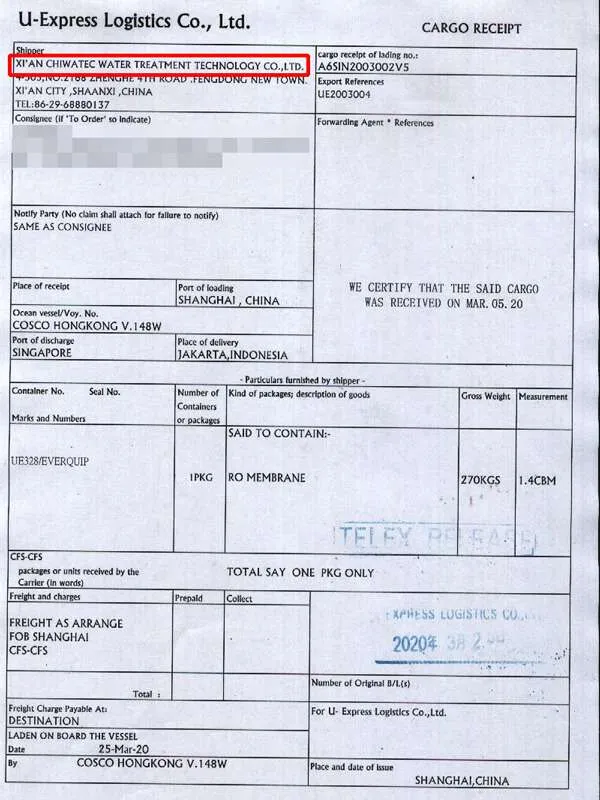
Xi’an CHIWATEC Water Treatment Technology provide the RO membrane to clients both inland and oversea with more than 10years experience. We manufacture our own brand Daltonen RO membrane and we are also the official distributor of Dupont, Toray, CSM, Nitto, LG and Vontron RO membrane. Whatever product you need, we cold meet your requirement.
Contact me for more info and best price.