The fouling density index SDI is the most widely accepted measure of reverse osmosis feed water quality. The Silt Density Index (SDI) test quantifies how fast suspended solids, colloids, and organic matter plug a standardized 0.45 µm filter. An SDI below 5 is essential for stable RO operation, and operators target values below 3 for optimal membrane life.
This guide covers the full determination method for the fouling density index SDI: the ASTM D4189 test principle, equipment setup, step-by-step procedure, calculation formula, result interpretation, and the accuracy factors every operator must control. For the complete upstream train, see our RO membrane pretreatment process guide.
*Last Updated: September 2026 | Industry-Verified Technical Data
Fouling Density Index SDI: Importance in RO System Pretreatment
The RO membrane feed water requirements guide ranks the fouling density index SDI as the single most important influent quality indicator. SDI captures cumulative fouling behavior of colloidal materials, fine particles, and organic matter that turbidity readings often miss. A clear sample can still carry a high SDI and foul RO elements within weeks.
- SDI below 3: low fouling potential; standard pretreatment supports 3-5 year membrane life.
- SDI 3-5: moderate fouling potential; enhanced pretreatment and more frequent cleaning are required.
- SDI above 5: pretreatment is inadequate; rapid membrane fouling and short element life follow.
RO system designers use these tiers to size pretreatment. Operators verify the same tiers with routine testing, exactly as our RO membrane operating guide describes for daily parameter control.
Standard Determination Method for Fouling Density Index SDI
The standard determination method for the fouling density index SDI follows ASTM D4189, the Standard Test Method for Silt Density Index (SDI) of Water. The principle is simple: measure the time needed to filter a fixed volume of water through a 0.45 µm membrane at a constant pressure of 30 psi (207 kPa). Faster plugging means higher fouling potential.
The SDI test requires this equipment set:
- Filter holder designed for 47 mm diameter membrane discs.
- Pressure regulator holding feed pressure at 30 psi ± 2 psi.
- Pressure gauge with a 0-60 psi range.
- Graduated cylinder of 500 mL or similar calibrated volume.
- Tubing, shut-off valves, and a timer accurate to 0.1 seconds.
- 0.45 µm membrane filters from one consistent manufacturer and lot.
Lot consistency matters because membrane pore distribution varies between batches. Mixing lots across test sessions adds 5-10% noise and makes trend comparisons unreliable.
Assembly of SDI Test Equipment
Correct assembly of the SDI test device determines whether the result represents real feed water quality. Connect the test device at a sampling point on the RO system inlet pipe, and always install it upstream of chemical injection points such as antiscalant or chlorine dosing. Sampling downstream gives misleadingly optimistic values.
- Mount a new 0.45 µm membrane disc in the holder using flat tweezers. Never reuse a membrane; its pores stay permanently blocked after one test.
- Confirm the O-ring is clean and seated correctly in the holder groove before closing the housing.
- Avoid touching the membrane with bare hands; skin oils contaminate the surface and change flow resistance.
- Open the exhaust valve and bleed air until a steady, bubble-free stream flows.
- Adjust the pressure regulator to 30 psi with water flowing freely through the assembly.
One complete test consumes one membrane disc and roughly 1-1.5 L of water. Keep spare discs from the same lot on hand for triplicate runs.
SDI Test Procedure: Step-by-Step Instructions
Run every fouling density index SDI measurement with the same procedure so results stay comparable across weeks and seasons:
- Record the water temperature before the test starts.
- Flush the test line for 2-5 minutes with the filter holder open and no membrane installed, to obtain a representative sample.
- Close the valve, install a fresh 0.45 µm membrane with flat tweezers, and reseal the holder.
- Open the valve and set the pressure regulator to 30 psi (207 kPa) with water flowing freely.
- Start the timer at the same moment filtration begins.
- Record t1, the time in seconds to collect the first 500 mL sample.
- Keep filtration running for the total elapsed test time T, normally 15 minutes for RO feed water.
- At time T, record t2, the time in seconds to collect a second 500 mL sample.
- If t2 exceeds 60 seconds before T is reached, stop and note the actual elapsed time.
- Verify the temperature did not drift more than 1 °C from the start reading.
Operators can use T = 5 or 10 minutes for heavily fouled water that plugs a 15-minute membrane too fast to finish. Label every result with its T value; SDI5, SDI10, and SDI15 are not interchangeable.
SDI Calculation Formula and Interpretation
Calculate the fouling density index SDI with the standard ASTM formula:
SDI = (1 – t1 / t2) × 100 / T
where t1 is the initial time in seconds to collect 500 mL, t2 is the final time in seconds to collect 500 mL after the test period, and T is the total elapsed test time in minutes (5, 10, or 15). Use the table below to convert the SDI result into an RO system decision:
| SDI Value | Fouling Level | RO System Recommendation |
| Below 3 | Low fouling potential | Ideal for RO operation; standard pretreatment is sufficient |
| 3-5 | Moderate fouling potential | Enhanced pretreatment recommended; monitor regularly |
| Above 5 | High fouling potential | Pretreatment inadequate; redesign required before RO |
| 6.7 (maximum) | Extreme fouling potential | Test invalid when t2 exceeds 60 s; improve pretreatment first |
If t2 exceeds 60 seconds before the target time T is reached, assign the maximum SDI of 6.7. That ceiling signals water unsuitable for direct RO feed, and the likely consequence is the rapid fouling described in our types of RO membrane fouling guide.
Factors Affecting SDI Test Accuracy
Several factors distort fouling density index SDI accuracy if left uncontrolled:
- Temperature swings above 1 °C change water viscosity and alter filtration time by roughly 2% per degree Celsius.
- Membrane filter variability between lots shifts results by 5-10%; use one manufacturer and lot.
- Pressure drift outside 30 psi ± 2 psi invalidates comparison against standard SDI guidelines.
- Air bubbles trapped in the holder or tubing add error to volume measurement.
- Sampling after antiscalant or chlorine injection reports optimistic values that hide real fouling potential.
- Single measurements carry random error; run every test in triplicate and report the average.
If triplicate results vary by more than 0.5 SDI units, investigate the cause before accepting any value. Consistent, accurate SDI data is the early-warning layer of every RO membrane fouling prevention strategy.
Conclusion
The fouling density index SDI determination method gives RO operators a fast, standardized read on feed water fouling potential. Run the ASTM D4189 procedure at 30 psi through a 0.45 µm membrane, record t1 and t2 over a 15-minute window, and apply the SDI formula to keep feed water below 5 and ideally below 3. Control temperature, membrane lot, pressure, and sampling point, and confirm every result in triplicate.
Need application support for RO membranes or pretreatment design? Contact our team at [email protected], [email protected], or [email protected].
FAQ: SDI Testing and RO Feed Water Quality
Q1: How often should operators measure SDI on RO feed water?
Test at commissioning, then on a routine schedule that matches raw water variability. Surface water and wastewater feeds justify daily or weekly SDI15 checks; stable well water can run monthly. Always re-test after any pretreatment change, filter media replacement, or seasonal raw water shift.
Q2: Why is a 0.45 µm membrane used in the SDI test?
The 0.45 µm pore size is the ASTM D4189 standard because it retains the colloidal and particulate fraction that drives RO fouling. The 47 mm disc format keeps test volume small and flow times measurable. Membranes must come from a consistent manufacturer and lot for reproducible comparisons.
Q3: What is the difference between SDI5, SDI10, and SDI15?
The number is the total elapsed test time T in minutes. SDI15 is the RO industry standard. Use SDI5 or SDI10 for high-fouling water where the membrane plugs to a 60-second t2 before 15 minutes elapse; at that point the test is invalid and the maximum SDI of 6.7 applies.
Q4: Why does the SDI test use 30 psi instead of RO operating pressure?
The test normalizes pressure to 30 psi (207 kPa) so results are comparable across sites, operators, and time. RO systems run far higher pressures, but the SDI test measures relative fouling potential under standardized conditions, not real-system flux behavior.
Q5: Can SDI be measured after antiscalant injection?
No. Sample upstream of all chemical injection points. Antiscalant disperses particles and can lower the measured SDI, so downstream sampling reports optimistic water quality. The RO system then operates on feed water that fouls faster than the tests predicted.
Related Resources
Recommended Membrane Technology Guides
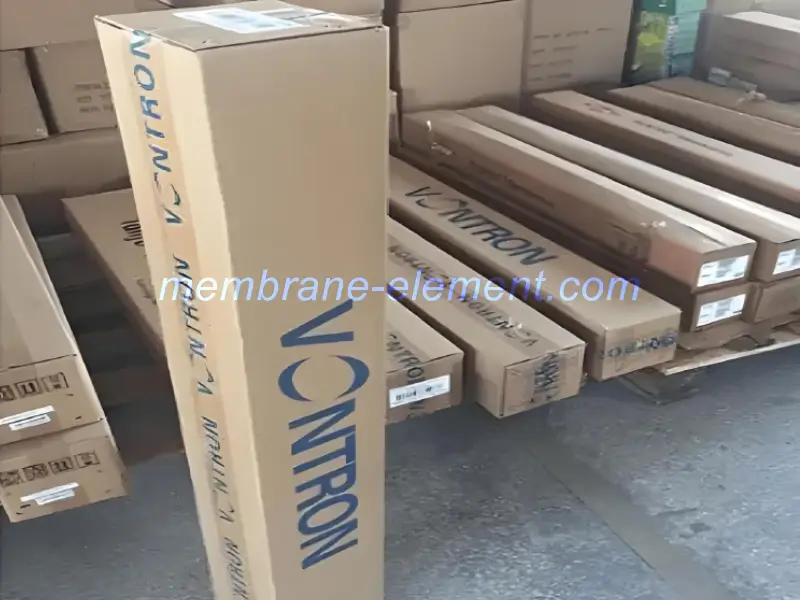
Xi’an CHIWATEC Water Treatment Technology provide the RO membrane to clients both inland and oversea with more than 10years experience. We manufacture our own brand Daltonen RO membrane and we are also the official distributor of Dupont, Toray, CSM, Nitto, LG and Vontron RO membrane. Whatever product you need, we cold meet your requirement.
Contact me for more info and best price.